

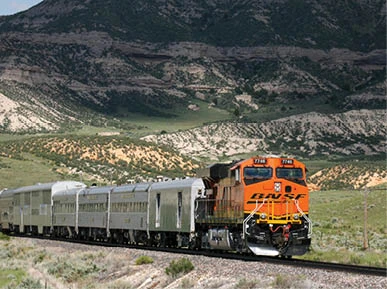
Helping customers meet their sustainability goals
Helping customers meet their sustainability goals
Rail is the most fuel-efficient way to move freight over land, and customers count on it to cut carbon emissions across their supply chains.
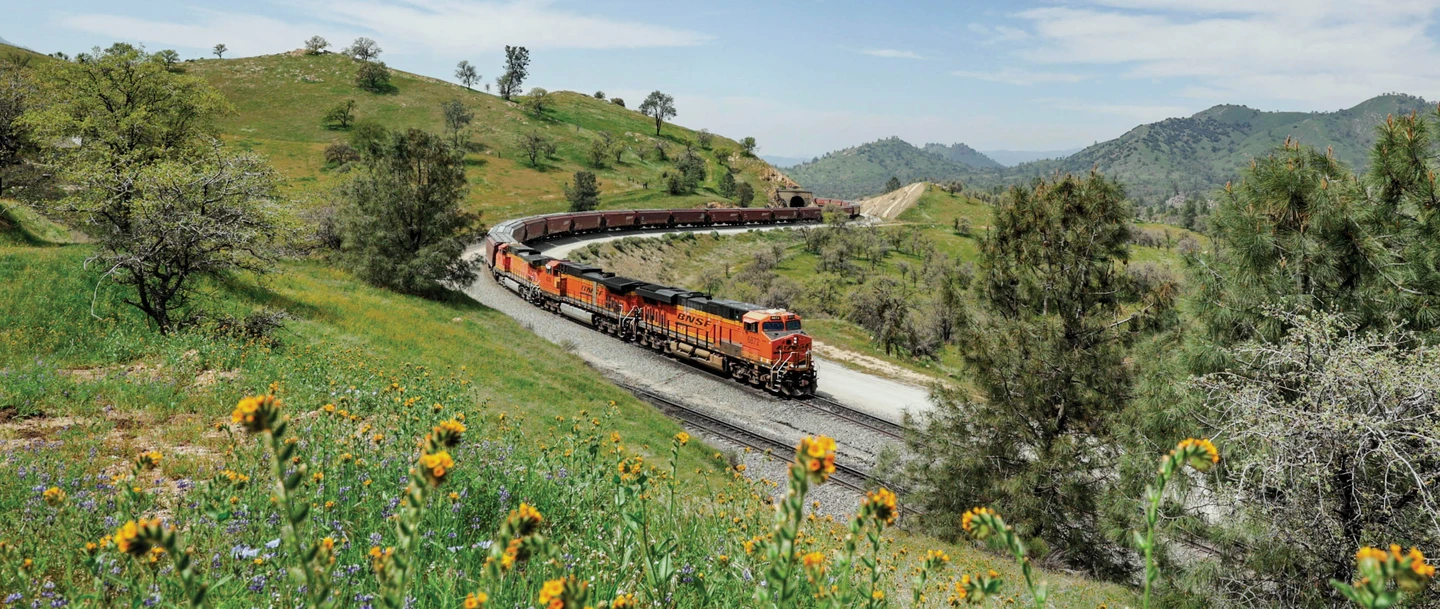
We work every day to minimize our impact on the planet and strengthen the long-term sustainability of every community we serve.
We work every day to minimize our impact on the planet and strengthen the long-term sustainability of every community we serve.
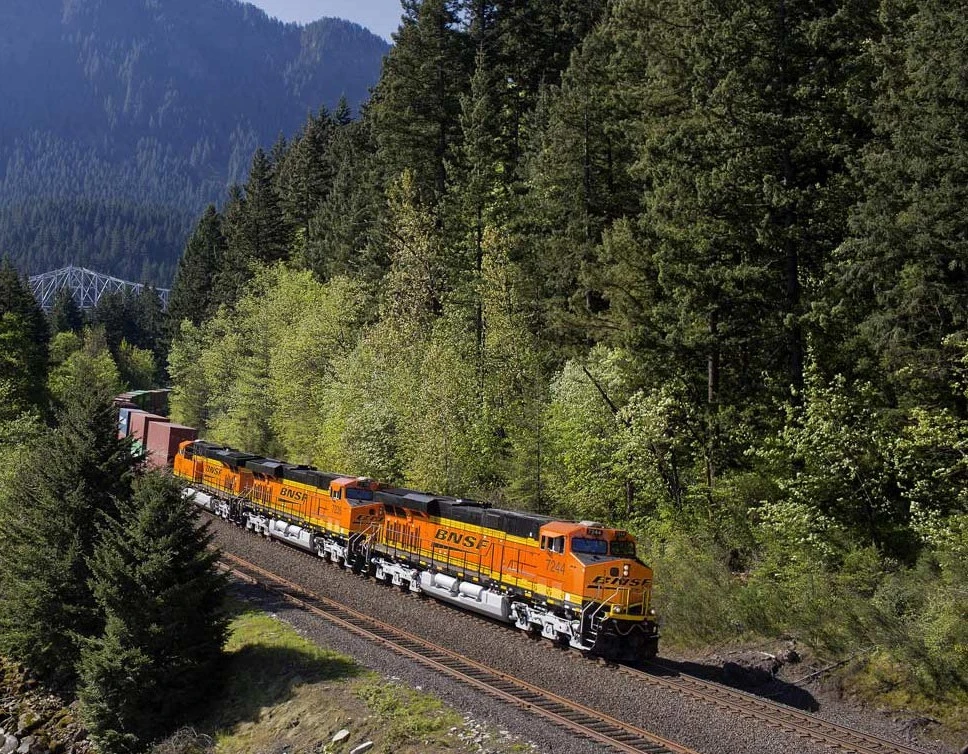
Railroads are the most fuel-efficient mode of surface freight transportation, and BNSF leads the rail industry in protecting air, land and water.
Rail carries one-third of the nation's freight — from the grain in your pantry to the fuel in your car. We move it while reducing emissions, saving fuel and easing highway congestion.
Rail also lowers supply chain costs, helping American businesses compete in the global market. A BNSF train can move 1 ton of freight nearly 500 miles on 1 gallon of diesel fuel.
Moving shipments by rail instead of truck lowers greenhouse gas (GHG) emissions by up to 75%. Our Corporate Impact Report details our progress on emissions reduction and other environmental initiatives.
Our emissions strategy
California law requires companies that make certain emissions-reduction claims to publish supporting information on their public website. The following disclosure meets that requirement under the Voluntary Carbon Market Disclosure Act ("AB 1305").
BNSF Railway Company ("BNSF") does not market, sell, purchase or use voluntary carbon offsets to meet its emissions reduction goal. BNSF does not have a net-zero or similar emissions reduction target. BNSF has, however, adopted a goal to reduce greenhouse gas (GHG) emissions as described in our Corporate Impact Report and summarized below.
BNSF set a science-based target, reviewed and approved by the Science Based Targets initiative (SBTi). We are committed to reducing absolute scope 1 and 2 GHG emissions — as well as the well-to-wheel GHG emissions associated with our locomotives — 30 percent by 2030, from a 2018 baseline year.
We plan to reach this goal two ways: by continuing to improve locomotive fuel efficiency and by increasing our use of renewable fuels. Each year, BNSF compiles an emissions inventory following the GHG Protocol, and an independent third party validates it. We publish emissions reduction updates annually in the Corporate Impact Report.
Forward-looking statements
Certain statements in this disclosure, the Corporate Impact Report and the supporting documents regarding BNSF's goals and commitments may be considered forward-looking. Actual future results, including achievement of our goals and commitments, are subject to risks, uncertainties and other factors that could cause results to differ materially from those expressed or implied by this disclosure and its related materials. Readers should consider these statements alongside information published in BNSF press releases and in Burlington Northern Santa Fe, LLC's filings with the Securities and Exchange Commission.
Rail freight lowers the country's overall transportation emissions and carbon footprint. That matters in regions working to meet Clean Air Act requirements and improve quality of life for residents.
Rail consistently outperforms trucks on carbon and particulate emissions per ton-mile. Every load we take off the highway cuts carbon dioxide emissions.
Improving fuel efficiency reduces emissions immediately. We are also developing new technology, monitoring our performance and reviewing how efficiently we operate to find further reductions.
Railroads are the most fuel-efficient mode of surface transportation. Steel wheels on steel rails, combined with the low aerodynamic drag of a single train pulling hundreds of loads, give rail a clear advantage over long-haul trucking. Trains are more than three times as fuel efficient as long-haul trucks.
Because our locomotives run on diesel, energy efficiency is one of our top priorities — it reduces both our environmental impact and our operating costs.
Better operating and maintenance practices drive much of our progress:
Our communities and customers need the value and efficiency of our railroad more than ever. That is why we use a range of sustainable technologies to reduce the environmental impact of our operations.
Wide-span electric cranes BNSF was the first U.S. rail carrier to use wide-span electric cranes, which produce zero on-site emissions and sharply reduce the number of trucks needed to move containers at our intermodal facilities. These cranes now operate in Chicago, Kansas City, Memphis and Seattle.
Automated gates More than 85% of the shipments moving through BNSF intermodal facilities pass through an automated gate. These gates use digital cameras to record units entering and exiting the facility. The efficiency they create has cut truck idling time — and the emissions that come with it — by 50% at every facility equipped with the technology.
Energy-efficient locomotives Over the past decade, we upgraded most of our locomotive fleet to cleaner, more energy-efficient technology. Energy management systems optimize throttle and brake use, and automatic start/stop devices prevent unnecessary idling. Together, these technologies increase fuel efficiency and cut carbon dioxide and particulate emissions.
Future technology testing We test emissions-reducing technology in and around our rail yards. The California Air Resources Board awarded BNSF and the San Joaquin Valley Air Pollution Control District a $22.6 million grant to develop and test a battery-electric locomotive. We will test it paired with diesel locomotives on freight trains running between Stockton and Barstow, California. The locomotive is expected to store 2,400 kilowatt-hours of power and reduce fuel consumption 10%–15% on that route.
We are also piloting:
Less congestion on our highways means safer roads and a cleaner environment, and rail is a key part of the solution.
BNSF and other railroads reduce congestion by taking long-haul trucks off the road. A single freight train can replace several hundred trucks, so every container shipped by rail means one less long-haul truck on the highway. That eases congestion, reduces pollution and saves energy.
As U.S. trucking companies work to lower fuel costs, overcome driver shortages and meet demand, they increasingly turn to rail—good news for our environment and the nation's roadways.
Rail is the most fuel-efficient way to move freight over land, and customers count on it to cut carbon emissions across their supply chains.