
Works well with others: BNSF’s case for collaboration vs. consolidation
By SUSAN GREEN | Staff Writer
Nov 17, 2026
The clock is ticking for the public and stakeholders to submit comments by November 18 to the Surface Transportation Board (STB) on the Union Pacific (UP) and Norfolk Southern (NS) railroads’ $85 billion merger proposal.
But more than a year after the proposal was announced, a central question remains unresolved: How does reducing the number of Class I railroads and creating one that would carry half of U.S. freight rail traffic preserve and enhance competition for customers, communities and the U.S. economy?
That question is ultimately up to the STB to decide through its review process. Central to the STB decision is whether the proposed merger meets the high bar of being in the public interest by enhancing competition in the U.S. rail network.
“At BNSF, we believe in collaboration – not consolidation – to expand service and preserve a balanced, customer-focused network,” said BNSF Executive Vice President & Chief Marketing Officer Tom Williams. “Today’s system is built on multiple transcontinental options for rail customers that provide routing flexibility, service options and competitive tension across major lanes. That structure is not incidental – it’s the foundation of how freight moves efficiently and reliably across the country.”
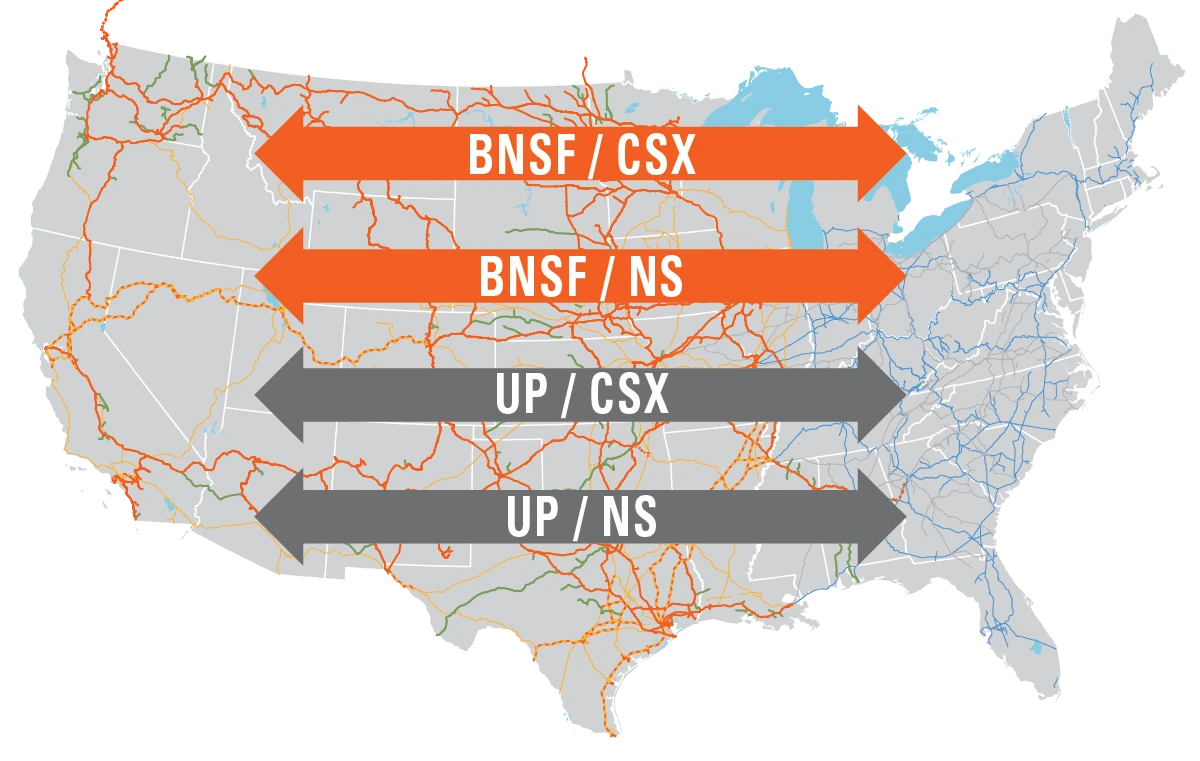
Currently the two railroads in the West – UP and BNSF – and the two in East – Norfolk Southern and CSX – exchange shipments going and coming from each directionally through interline agreements. These allow each railroad to operate their own systems while partnering with one another via seamless gateway interchanges, for example, in Chicago (often taking under an hour for crew and locomotive handling).
Long before the UP-NS merger proposal, BNSF and CSX expanded their joint intermodal service linking Los Angeles with the Ohio Valley and points in the Northeast. Since then, we added lanes connecting the West Coast, Phoenix and Texas to hubs in the Southeast and East, like Atlanta, Charlotte, North Carolina, and Jacksonville, Florida. We also collaborate with NS on interline service via Chicago and Birmingham, Alabama.
“The interline interchanges we have in place already achieve truck-to-rail conversion and long-haul reliability without corporate mega-mergers,” added Farah Lawler, BNSF vice president of service design. “Keeping the four distinct Class I freight railroads separate protects shipper choice and prevents regional monopolies.”
BNSF has joined the Stop the Rail Merger Coalition, whose members include rail customers and rail unions where you can learn more about our position. Remember, there is still time to be heard. If you missed the earlier deadline to participate, you can file a Notice of Intent to Participate and share your comments by November 18.